

5 Nuanced Signs a Senior Couple is Ready for a New Chapter
Recognizing when senior couples need a more supportive environment can be tricky. Discover the five nuanced signs it might be time to explore your options.
When an older adult lives alone, the indicators that they need a hand are often starkly visible. A refrigerator left completely empty or a stack of forgotten bills on the counter tells a clear, immediate story.
For senior couples, however, the narrative is entirely different.
Couples are masters of silent choreography. For decades, they have instinctively covered for one another's shortcomings. If one partner's memory begins to fade, the other smoothly finishes their sentences. If one partner's balance becomes unsteady, the other quietly takes over the heavy lifting. They form a beautiful, defensive ecosystem that masks the growing difficulties of managing a home.
Because they lean on each other so perfectly, the indicators that they need a more supportive environment are rarely loud. Instead, they are woven into subtle shifts in their daily rhythm.
If you are trying to evaluate how your parents or spouse are truly managing at home in the South Hills, look past the obvious and watch for these five nuanced shifts in their shared ecosystem.
The Hidden Toll of Spousal Caregiving
In a healthy partnership, chores and daily responsibilities are relatively balanced. A major indicator of a shifting dynamic is when the relationship silently morphs from a partnership of equals into a constant cycle of caregiving.
Look closely at the spouse who is handling the bulk of the work. Are they looking increasingly exhausted? Is their own health starting to decline under the physical and mental weight of keeping the household afloat? Data published by the Family Caregiver Alliance notes that spousal caregivers experience significantly higher rates of physical exhaustion and chronic stress compared to non-caregivers.
When one partner spends all their emotional energy acting as a wellness provider or a housekeeper, they lose the ability to just be a spouse. Stepping into a community that builds care right into the foundation allows the caregiving spouse to drop the heavy lifting and reclaim their rightful role as a romantic partner.
The Shrinking Radius of Their World
Take a look at the car, the calendar, and the kitchen. Couples who used to thrive on hosting Sunday dinners, attending local community events, or taking regular drives out around Upper St. Clair may slowly, quietly withdraw.
This withdrawal is rarely a conscious choice to isolate. Instead, it is often a defense mechanism against a world that is becoming too complicated to navigate together.
If driving at night causes anxiety, or if managing the physical steps at a favorite restaurant has become a logistical hurdle, they will simply choose to stay home. According to research tracked by the National Institute on Aging (NIA), prolonged social isolation in seniors carries severe health risks, including an increased likelihood of cognitive decline and cardiovascular complications. A vibrant community removes the friction of travel, bringing a lively social circle right to their front door on a single flat level.
The Refrigerator Illusion
Open the fridge during your next visit. It might look fully stocked at a glance, but look closer at what is actually inside.
Are you seeing frozen dinners, pre-packaged processed foods, or expired items instead of fresh, nutrient-dense meals?
Cooking a fresh meal from scratch requires significant physical stamina, fine motor control, and cognitive planning. When those tasks become taxing, couples often default to whatever is easiest to open, rather than what is healthier to eat. Nutritional guidance from the MyPlate Resources for Older Adults emphasizes that proper, nutrient-dense meals are vital for maintaining bone density and immune function as we age. Moving into an environment with chef-led, restaurant-style dining ensures they can both sit back and enjoy scratch-cooked meals without any of the cleanup.
The Maintenance Defensive Stand
Listen to the way they talk about their house. If a broken appliance, an overgrown lawn, or a minor roof leak triggers intense anxiety or immediate denial, it is a sign that the home has transitioned from an asset into an emotional burden.
Couples often become deeply defensive of their living space because they associate the house with their independence. They will fiercely insist everything is fine because they fear a move means downsizing into a cramped, sterile environment.
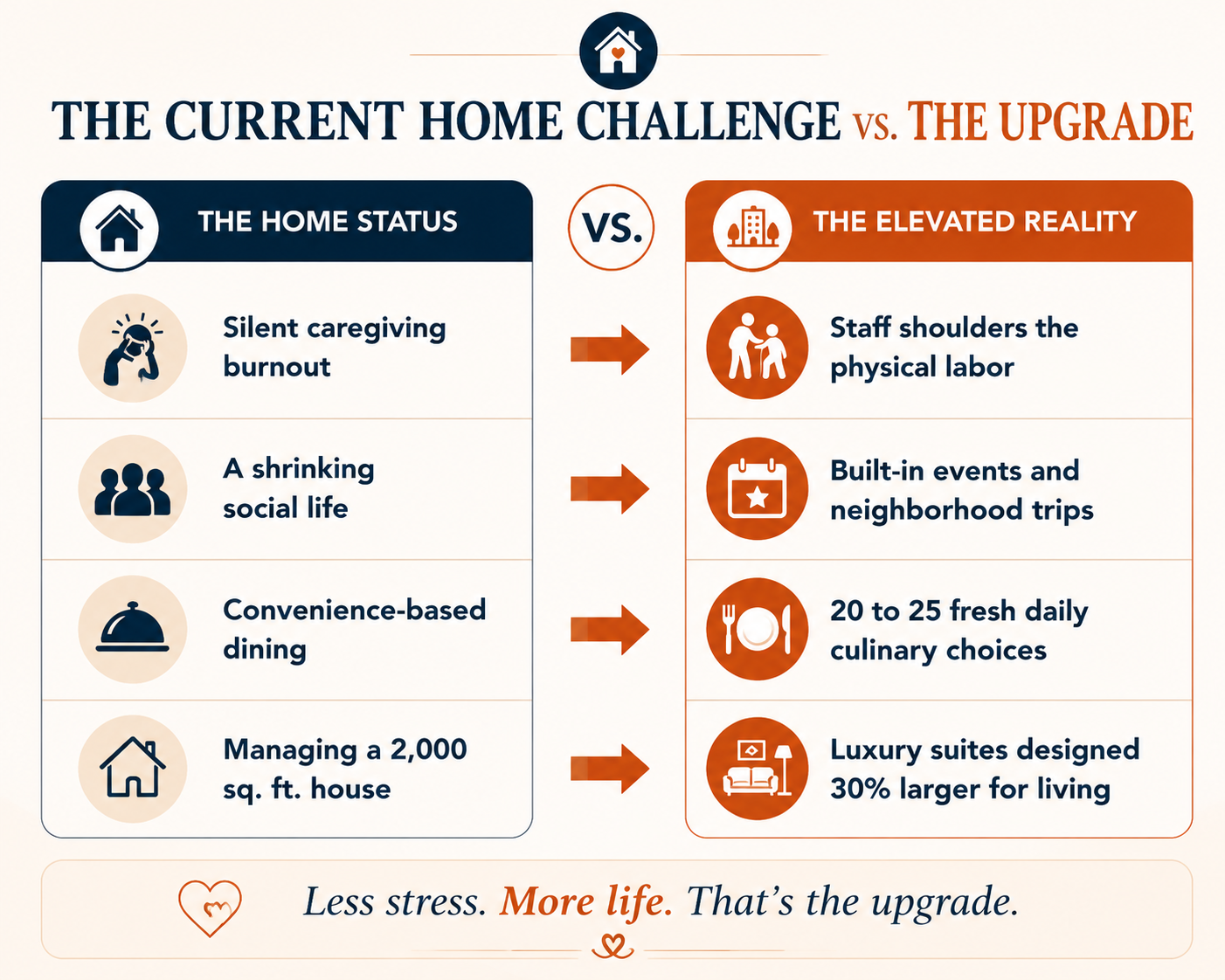
The reality is that senior living doesn't have to mean living small. At The Grand Residence, our luxury suites run 30% larger than the industry average. This gives couples plenty of room to bring their favorite living room sets, display treasured heirlooms, and even host family gatherings, all while completely eliminating the stress of home maintenance.
Diverging Healthcare Tracks
Perhaps the most stressful hurdle for an aging couple is when their physical or cognitive needs begin to move in completely opposite directions. One partner may remain entirely physically independent while the other begins to experience progressive memory loss or severe mobility limitations. Clinical patterns documented by the Alzheimer's Association show that as cognitive changes advance, the safety and structural needs of a living space must adapt accordingly.
In traditional corporate senior living networks, this divergence forces a painful separation. One spouse is sent to an assisted living wing while the other is placed in a separate memory care building.
We believe that a change in health should never force a change in your marital status. Under a true aging in place philosophy, couples stay together. Specialized care, proactive wellness checks, and medication management are delivered directly inside their shared private suite. Each partner receives exactly the level of attention they need while waking up next to the person they love every single morning.
Keeping the Love, Losing the Burden
Recognizing these signs isn't a symptom of failure; it is the beginning of a proactive strategy to protect the lifestyle your parents or spouse worked a lifetime to build.
Since 1984, our family has dedicated 42 years to senior care, establishing a rich legacy of trusted support. Over more than four decades, our family-owned community has perfected the art of senior hospitality. We manage every daily detail, from cooking and cleaning to complex medical needs, with decades of hands-on expertise. We design our luxury spaces so couples can step away from the exhausting burdens of household management and simply focus on continuing their love story together.
If you are noticing the subtle signs of a script shift in your loved ones' lives, let's talk. Reach out to our local Upper St. Clair team at (412) 833-2500 to schedule a tour and enjoy lunch on us.
Come See It for Yourself
The best way to know if The Grand Residence is right is to walk through the door. Take a tour, meet the team, have lunch if you like. No pressure, no sales pitch, just a chance to see what life here actually feels like.